


Manchester, an ancient city with a rich history and heritage, has long been a hub of industrial, political, and cultural activity. Over the centuries, many prominent figures have visited the city, including the virtuoso violinist Niccolò Paganini. Below is an exploration of his visits to Manchester and his impact on the city’s cultural landscape. Next on manchester-trend.
Who Was Niccolò Paganini?
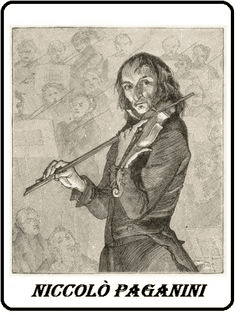
Niccolò Paganini was an Italian violinist, composer, and one of the most renowned virtuosos of his time. His unmatched skill on the violin, combined with his groundbreaking compositions, captivated audiences worldwide. Paganini’s performances were often regarded as almost supernatural due to his technical prowess and stage presence.
A true child prodigy, Paganini began playing the mandolin at age five and the violin at seven. By 11, he was already performing in public with remarkable confidence and mastery. Notably, Paganini was one of the first solo performers to play entirely from memory, eschewing sheet music, as he believed in internalising compositions.
However, Paganini’s life was not without its challenges. While his early fame brought him recognition, it also led to struggles with gambling, alcohol, and a reputation as a notorious womaniser. Despite these difficulties, Paganini’s talent ensured his legacy as one of the most significant figures in classical music.
Paganini passed away at the age of 57 in Nice, France, succumbing to throat cancer in 1840.
Paganini’s Visit to Manchester
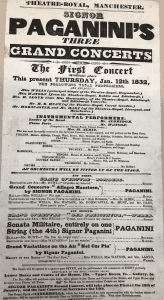
Paganini first visited Manchester in January 1832 as part of the city’s Manchester Music Festival. At the time, the industrial city took great pride in hosting a world-famous violinist and composer, whose reputation as a “universal virtuoso” preceded him.
He travelled to Manchester in a grand black carriage drawn by four horses, rented from London, accompanied by his orchestra conductor, servant, and porter on horseback. Paganini’s arrival was a spectacle, widely covered by local newspapers.
During his first visit, Paganini performed three concerts at the Royal Theatre in Manchester. The city’s residents were eager to witness his legendary performances, which were characterised by exceptional technical ability and emotional depth. His repertoire included his own compositions such as:
- 24 Caprices
- Le Streghe
- The Carnival of Venice
- Nel cor più non mi sento
These pieces were considered nearly impossible for other musicians to replicate, leaving the Manchester audience in awe of his seemingly supernatural abilities. His concerts were more than just musical performances—they were extraordinary spectacles that deeply impressed all who attended.
Touring the United Kingdom
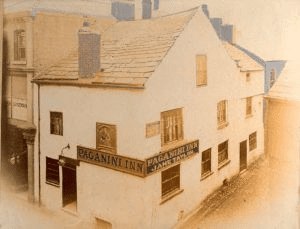
Paganini’s 1830s tour of the United Kingdom included performances in major cities and smaller towns. He played in Blackburn, where a local hotel was renamed The Paganini Inn in his honour. His willingness to perform in lesser-known locales reflected his ambition to bring music to a wider audience.
Manchester was one of the prominent cities he visited, where he made an unforgettable impression. Following his first visit in 1832, Paganini returned to Manchester in September 1838 during his farewell tour of Britain. This marked his final concert in the city, once again drawing large crowds to the Royal Theatre.
Throughout his six-year British tour, Paganini enjoyed immense popularity. Tickets to his concerts were often double the usual price, a testament to his extraordinary appeal. His concerts not only brought significant financial success but also cemented his legacy as a cultural icon.
Legacy of Paganini’s Visits to Manchester
Paganini’s two visits to Manchester in 1832 and 1838 were landmark events that left a lasting impact on the city’s cultural life. His unparalleled performances inspired local audiences and contributed to the city’s burgeoning reputation as a hub of musical excellence. Even today, Paganini’s association with Manchester remains a point of pride for the city’s cultural heritage.
Through his artistry, Paganini brought an elevated appreciation for music to Manchester, enriching its cultural identity and leaving an indelible mark on its history.