


In 1959, Manchester hosted one of the most iconic musicians the world has ever known – Louis Armstrong. By that time, he was already a renowned jazz performer, and the residents of Manchester eagerly anticipated his concert. Without a doubt, his performance in the heart of Northern England left an indelible mark on the city’s musical culture and on those fortunate enough to witness it. Here’s more on this historic event on manchester-trend.
A Bit About a Mid-20th Century Star
Louis Armstrong is believed to have been born in New Orleans, USA. Historians commonly cite his birthdate as August 4, 1901, although some records suggest it might have been July 4, 1900. Armstrong grew up in poverty in a disadvantaged neighbourhood. He started school at the age of six but dropped out by 11, joining a boys’ quartet that performed on the streets for money. It was on the streets of New Orleans that Armstrong was introduced to music and taught to play by ear by a cornet player, Dago Tony.
Armstrong’s journey to success was anything but easy. Early in his career, he played in brass bands, performed on riverboats in New Orleans, and collaborated with various music groups. By the age of 20, he had learned to read music and became one of the first jazz performers to extend solo performances on the trumpet. Armstrong brought his unique individuality and style to jazz and distinguished himself by singing during his performances—a feature that captivated audiences.
Thus, Armstrong secured a prominent place in jazz culture. He became a key figure in the evolution of jazz, not just in the United States but globally. A cultural icon of the 20th century, Armstrong was instrumental in elevating jazz to an international art form.
A Jazz Legend Performs in Manchester
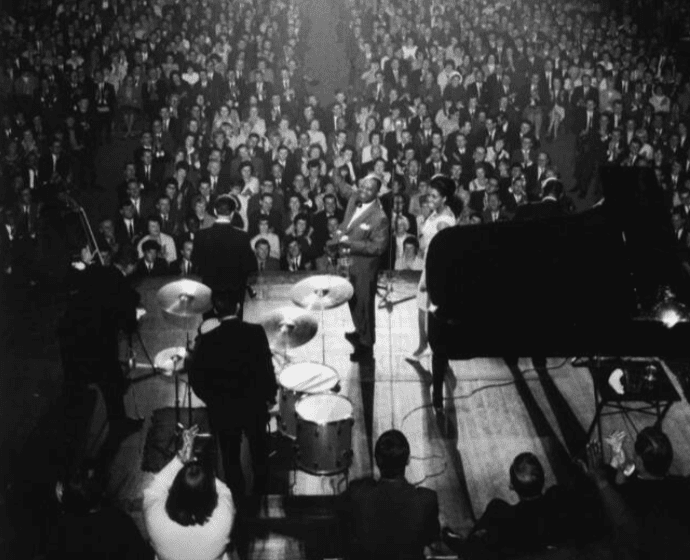
By the mid-20th century, Louis Armstrong had achieved global stardom. His distinctive raspy voice, boundless charisma, and immense talent had introduced millions to the world of jazz. When Armstrong visited Manchester in 1959, it was a monumental event.
At the time, Manchester was not a hub for jazz music. The city was better known for its industrial roots and legendary football teams. However, news of Armstrong’s visit immediately made it one of the most anticipated events of the year.
The concert venue was “Kings Hall,” also known as “Belle Vue.” Scheduled for 9 March 1959 at 7:30 PM, the event took place in a location of significant cultural importance for Manchester. Kings Hall was a centre for classical and contemporary performances, and Armstrong’s appearance marked a historic milestone for both the venue and the city.
On the evening of 9 March, a massive crowd gathered at Kings Hall. People of all ages and musical preferences eagerly awaited the chance to witness the jazz legend in person. As Armstrong took to the stage, trumpet in hand, the audience erupted in applause. His performance was not just a jazz concert; it was a heartfelt sharing of his soul with Manchester.
Accompanied by his talented band, “All Stars,” Armstrong delivered a setlist spanning his career, from early jazz pieces to the swing melodies that had made him famous worldwide. His emotive raspy voice and masterful trumpet playing mesmerised the Manchester audience.
Armstrong’s visit was more than a musical event; it played a vital role in promoting jazz and the arts. It also broke cultural and geographical barriers. In an era marked by racial tensions and social change, Armstrong’s visit to a predominantly white city in Northern England was profoundly symbolic. His music transcended boundaries, prejudices, and stereotypes.
For many Mancunians, Armstrong’s concert was their first live jazz experience. This introduction to jazz had a lasting impact on the city’s musical landscape and helped popularise the genre across the UK. Armstrong’s influence spurred local musicians to explore jazz in their work and led to the emergence of new jazz clubs and festivals in Manchester. Over time, the city became a significant post-war hub for jazz development.
Armstrong’s concert at Kings Hall was a transformative cultural moment for Manchester. His music not only entertained but also inspired, fostering a deeper appreciation for jazz. Through his artistry and ambassadorship, Armstrong united audiences across divides, leaving a legacy that endures in Manchester’s vibrant cultural history.